
In the highly competitive world of global investment banking, leadership moves are rarely quiet—and almost never as swift as the one involving Viswas Raghavan.
His dramatic transition from JPMorgan Chase to Citigroup in early 2024 captured the attention of Wall Street and beyond. Completed over a single weekend, the move was not only rapid but also financially significant, involving a compensation package reportedly worth around $52 million.
This episode underscores the fierce competition for top talent in global finance and reflects deeper shifts within the investment banking landscape.
A Weekend That Shook Wall Street
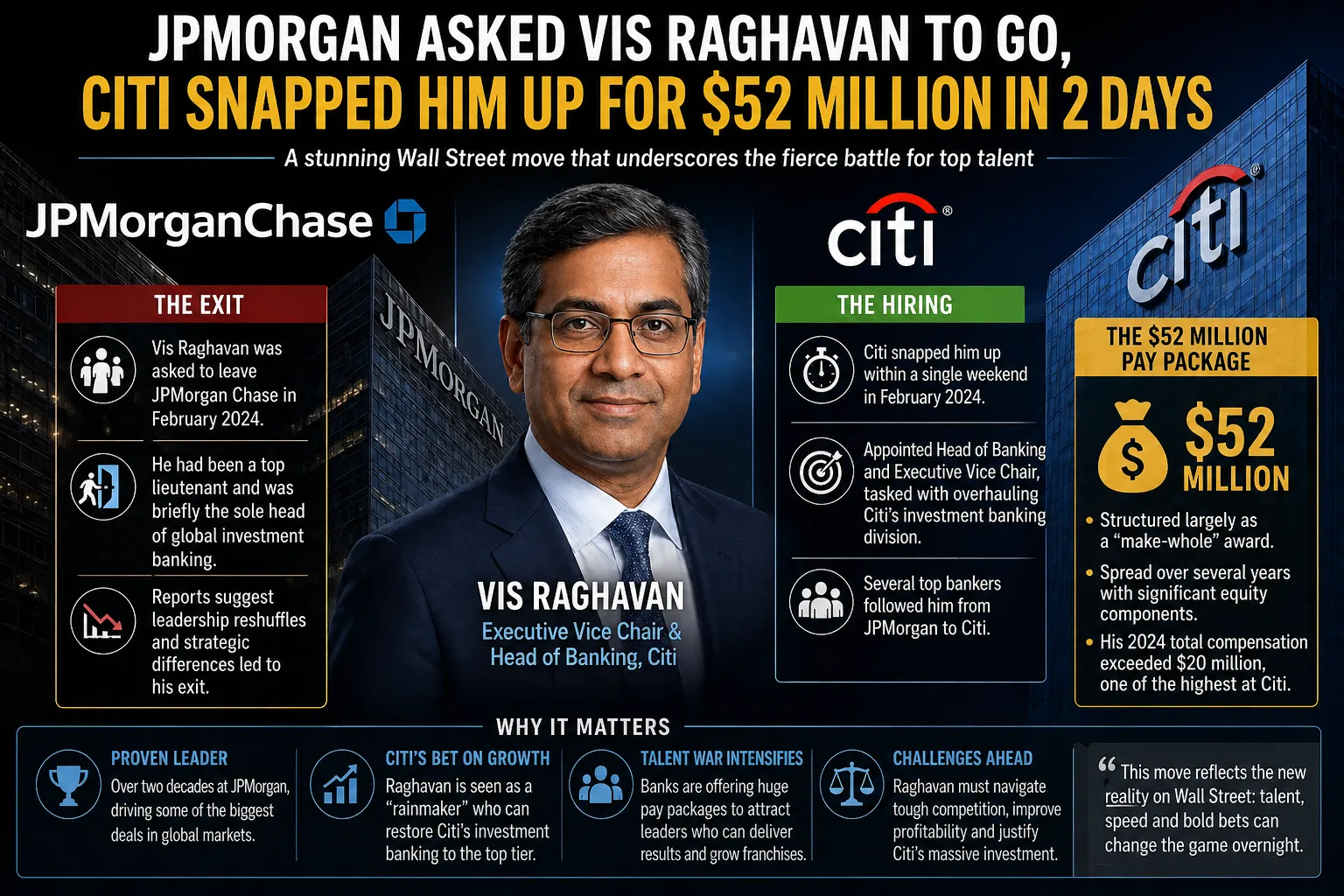
In February 2024, Raghavan’s departure from JPMorgan and immediate hiring by Citi unfolded with unusual speed. Within just two days, he moved from one of the world’s most powerful banking institutions to another, assuming a top leadership role at Citi.
At JPMorgan, Raghavan had built a formidable reputation over more than two decades. He rose through the ranks to become global co-head—and briefly sole head—of investment banking, playing a central role in major equity and debt transactions worldwide. His influence within the firm was significant, making his sudden exit all the more noteworthy.
While the exact internal reasons behind his departure were not publicly detailed, reports suggest that leadership reshuffles and strategic differences contributed to the decision. What is clear, however, is that Citi wasted no time in capitalizing on the opportunity.
Citi’s Strategic Bet on Leadership
Citi’s decision to bring in Raghavan was part of a broader effort to revive its investment banking division. Under CEO Jane Fraser, the bank had already embarked on a major restructuring aimed at improving performance and competitiveness.
Raghavan was appointed as head of banking and given the title of executive vice chair—placing him among the most powerful figures within the organization. His mandate was clear: transform Citi’s underperforming investment banking arm into a top-tier global player.
The speed of his hiring reflected both urgency and strategic intent. Citi viewed Raghavan not just as an executive, but as a “rainmaker”—someone capable of driving deals, attracting clients, and reshaping organizational culture.
The $52 Million Compensation Package
One of the most striking aspects of Raghavan’s move was the scale of his compensation. Citi offered a package valued at approximately $52 million, structured largely as a “make-whole” award. This type of compensation is designed to offset the deferred bonuses and stock options an executive forfeits when leaving a previous employer.
The package was spread over several years and included significant equity components, aligning Raghavan’s incentives with Citi’s long-term performance. In addition, his annual compensation has remained among the highest at the bank, with disclosures indicating a package exceeding $20 million in 2024 alone.
Such figures highlight the premium placed on top-tier leadership in investment banking, where individual executives can influence billions of dollars in deals and revenue.
Why Raghavan Matters
Raghavan’s importance lies not just in his experience, but in his track record. During his time at JPMorgan, he helped maintain the bank’s position as a global leader in investment banking. His expertise spans capital markets, mergers and acquisitions, and complex financial transactions.
At Citi, he has been tasked with replicating that success. Early indications suggest that his presence has already had a ripple effect:
-
Talent Migration: Several bankers have followed him from JPMorgan to Citi, strengthening the latter’s team.
-
Strategic Focus: Citi has intensified its efforts in key sectors such as technology, healthcare, and leveraged finance.
-
Cultural Shift: Raghavan is known for his disciplined, results-driven approach, which is reshaping internal dynamics.
His growing influence has even positioned him as a potential future CEO candidate, reflecting his rising stature within the organization.
The Talent War in Investment Banking
Raghavan’s move is emblematic of a broader trend: the intensifying competition for elite talent in global finance. Investment banks are increasingly willing to offer massive compensation packages to secure executives who can deliver results.
This “talent war” has several implications:
1. Escalating Compensation
Banks are offering larger and more complex pay packages, often tied to long-term performance.
2. Increased Mobility
Senior executives are more willing to switch firms, especially when strategic opportunities arise.
3. Organizational Disruption
High-profile moves can trigger ripple effects, including team departures and shifts in client relationships.
In Raghavan’s case, his departure from JPMorgan reportedly led to internal uncertainty, while his arrival at Citi sparked both optimism and tension among employees.
Risks and Challenges
While Citi’s investment in Raghavan signals ambition, it also carries risks. Large compensation packages can attract scrutiny from shareholders and regulators, particularly if performance targets are not met.
Moreover, transforming a global investment banking division is a complex task. Citi faces several challenges:
-
Competing with established leaders like JPMorgan and Goldman Sachs
-
Improving profitability and return on equity
-
Managing costs while investing in growth
Raghavan’s success will depend on his ability to balance these priorities while delivering tangible results.
A Defining Moment for Citi
The hiring of Raghavan represents a defining moment in Citi’s transformation journey. It reflects a willingness to take bold decisions and invest heavily in leadership to drive change.
Since his arrival, there have been signs of progress, including improved deal activity and increased market share in certain segments. However, the long-term impact of his leadership will only become clear over time.
What is certain is that his move has reshaped perceptions of Citi on Wall Street. Once seen as lagging behind its peers, the bank is now viewed as a serious contender in the investment banking space.
Conclusion
The rapid transition of Vis Raghavan from JPMorgan to Citi, sealed within a single weekend and backed by a $52 million package, is more than just a headline-grabbing event. It is a reflection of the evolving dynamics of global finance, where talent, strategy, and timing intersect.
For Citi, the move represents a calculated gamble—one that could redefine its position in the industry. For JPMorgan, it highlights the challenges of retaining top talent in an increasingly competitive environment.
Ultimately, Raghavan’s story is not just about one executive’s career move. It is about the high-stakes world of investment banking, where leadership decisions can shape the fortunes of entire institutions.
quorvel.shop quorvel.shop quorvel.shop quorvel.shop quorvel.shop quorvel.shop quorvel.shop quorvel.shop quorvel.shop quorvel.shop quorvel.shop quorvel.shop quorvel.shop quorvel.shop quorvel.shop quorvel.shop quorvel.shop quorvel.shop quorvel.shop quorvel.shop quorvel.shop quorvel.shop quorvel.shop quorvel.shop quorvel.shop quorvel.shop quorvel.shop quorvel.shop quorvel.shop quorvel.shop quorvel.shop quorvel.shop quorvel.shop quorvel.shop quorvel.shop quorvel.shop quorvel.shop quorvel.shop quorvel.shop quorvel.shop quorvel.shop quorvel.shop quorvel.shop quorvel.shop quorvel.shop quorvel.shop quorvel.shop quorvel.shop quorvel.shop quorvel.shop quorvel.shop quorvel.shop quorvel.shop quorvel.shop quorvel.shop quorvel.shop quorvel.shop quorvel.shop quorvel.shop quorvel.shop quorvel.shop quorvel.shop quorvel.shop quorvel.shop quorvel.shop quorvel.shop quorvel.shop quorvel.shop quorvel.shop quorvel.shop quorvel.shop quorvel.shop quorvel.shop quorvel.shop quorvel.shop quorvel.shop quorvel.shop quorvel.shop quorvel.shop quorvel.shop quorvel.shop quorvel.shop quorvel.shop quorvel.shop quorvel.shop quorvel.shop quorvel.shop quorvel.shop quorvel.shop quorvel.shop quorvel.shop quorvel.shop quorvel.shop quorvel.shop quorvel.shop quorvel.shop quorvel.shop quorvel.shop quorvel.shop quorvel.shop quorvel.shop quorvel.shop quorvel.shop quorvel.shop quorvel.shop quorvel.shop quorvel.shop quorvel.shop quorvel.shop quorvel.shop quorvel.shop quorvel.shop quorvel.shop quorvel.shop quorvel.shop quorvel.shop quorvel.shop quorvel.shop quorvel.shop quorvel.shop quorvel.shop quorvel.shop quorvel.shop quorvel.shop quorvel.shop quorvel.shop quorvel.shop quorvel.shop quorvel.shop quorvel.shop quorvel.shop quorvel.shop quorvel.shop quorvel.shop quorvel.shop quorvel.shop quorvel.shop quorvel.shop quorvel.shop quorvel.shop quorvel.shop quorvel.shop quorvel.shop quorvel.shop quorvel.shop quorvel.shop quorvel.shop quorvel.shop quorvel.shop quorvel.shop quorvel.shop quorvel.shop quorvel.shop quorvel.shop quorvel.shop quorvel.shop quorvel.shop quorvel.shop quorvel.shop quorvel.shop quorvel.shop quorvel.shop quorvel.shop quorvel.shop quorvel.shop quorvel.shop quorvel.shop
infinityinspires.com codecraftes.com linklaunches.com pixelperkes.com quantumquestes.com sunshinstates.com techsthrive.com webeswhiz.com webswisdoms.com