
Indian politics has witnessed the rise of many influential leaders, but only a few have left behind an ideological legacy that continues shaping the country decades after their death. One such figure is Syama Prasad Mookerjee — a politician, educationist, nationalist thinker, and social reformer whose contribution to India’s political history remains deeply significant.
Although modern discussions around Indian politics often focus on the Bharatiya Janata Party (BJP), fewer people fully understand the historical roots of the party and the role Mookerjee played in laying its ideological foundation. He founded the Bharatiya Jana Sangh in 1951, which later evolved into today’s BJP, now one of the world’s largest political parties.
Mookerjee’s political journey reflected a unique combination of nationalism, constitutional thinking, educational reform, and strong opposition politics during the early years of independent India. His influence helped shape debates around national identity, federalism, cultural nationalism, and the relationship between the state and society.
Early Life and Educational Excellence
Syama Prasad Mookerjee was born on July 6, 1901, in Kolkata into a respected Bengali family known for its contributions to education and public life. His father, Sir Ashutosh Mookerjee, was a highly respected judge and academician who played a major role in shaping modern education in Bengal.
From an early age, Mookerjee displayed exceptional academic ability. He studied at University of Calcutta and later became one of the youngest vice-chancellors in the institution’s history. His educational achievements earned him recognition not only as a scholar but also as a reform-minded intellectual.
As vice-chancellor, he focused on:
-
Improving academic standards
-
Expanding educational opportunities
-
Encouraging Indian languages and culture
-
Strengthening institutional independence
His leadership in education reflected his belief that nation-building required strong intellectual and cultural foundations.
Entry Into Politics
Mookerjee entered politics during a period of major political and social transformation in India. British colonial rule, rising nationalist movements, communal tensions, and debates over constitutional reforms were reshaping the political landscape.
Initially associated with regional politics in Bengal, he later emerged as a national figure. He served in the Bengal Legislative Council and became known for his administrative skills and sharp parliamentary arguments.
During the 1940s, he joined the Hindu Mahasabha and became one of its prominent leaders. However, his political approach was often more constitutional and parliamentary compared to some of the more aggressive ideological voices of the time.
Mookerjee strongly believed in democratic participation, constitutional governance, and the need for political alternatives within India’s emerging democratic system.
Role During Partition and Independence
The years leading to India’s independence were marked by communal violence, political negotiations, and the eventual partition of British India into India and Pakistan.
Mookerjee played an important role during this turbulent period, especially concerning the future of Bengal. He opposed the idea of a united Bengal becoming part of Pakistan and strongly advocated for the partition of Bengal to ensure that Hindu-majority areas remained within India.
His political intervention significantly influenced the eventual creation of the Indian state of West Bengal. Supporters often credit him with helping preserve West Bengal as part of India during partition negotiations.
At the same time, his critics argued that such positions contributed to growing communal polarization. Nevertheless, his influence during this period was undeniable.
Mookerjee in Independent India
After India gained independence in 1947, Jawaharlal Nehru invited Mookerjee to join the first Union Cabinet. He served as India’s Minister for Industry and Supply, becoming part of the early effort to shape the country’s post-independence economic framework.
As a cabinet minister, he supported:
-
Industrial development
-
Economic planning
-
National self-reliance
-
Administrative modernization
However, ideological differences between Mookerjee and Nehru gradually deepened, particularly over issues involving national integration, minority policies, and relations with Pakistan.
One of the most significant disagreements concerned the special constitutional status granted to Jammu and Kashmir under Article 370.
Opposition to Article 370
Mookerjee became one of the strongest critics of Article 370, which granted special autonomy to Jammu and Kashmir after independence.
He argued that:
-
India should have one unified constitutional structure
-
Separate arrangements weakened national integration
-
Multiple symbols of sovereignty could create long-term political complications
His famous slogan:
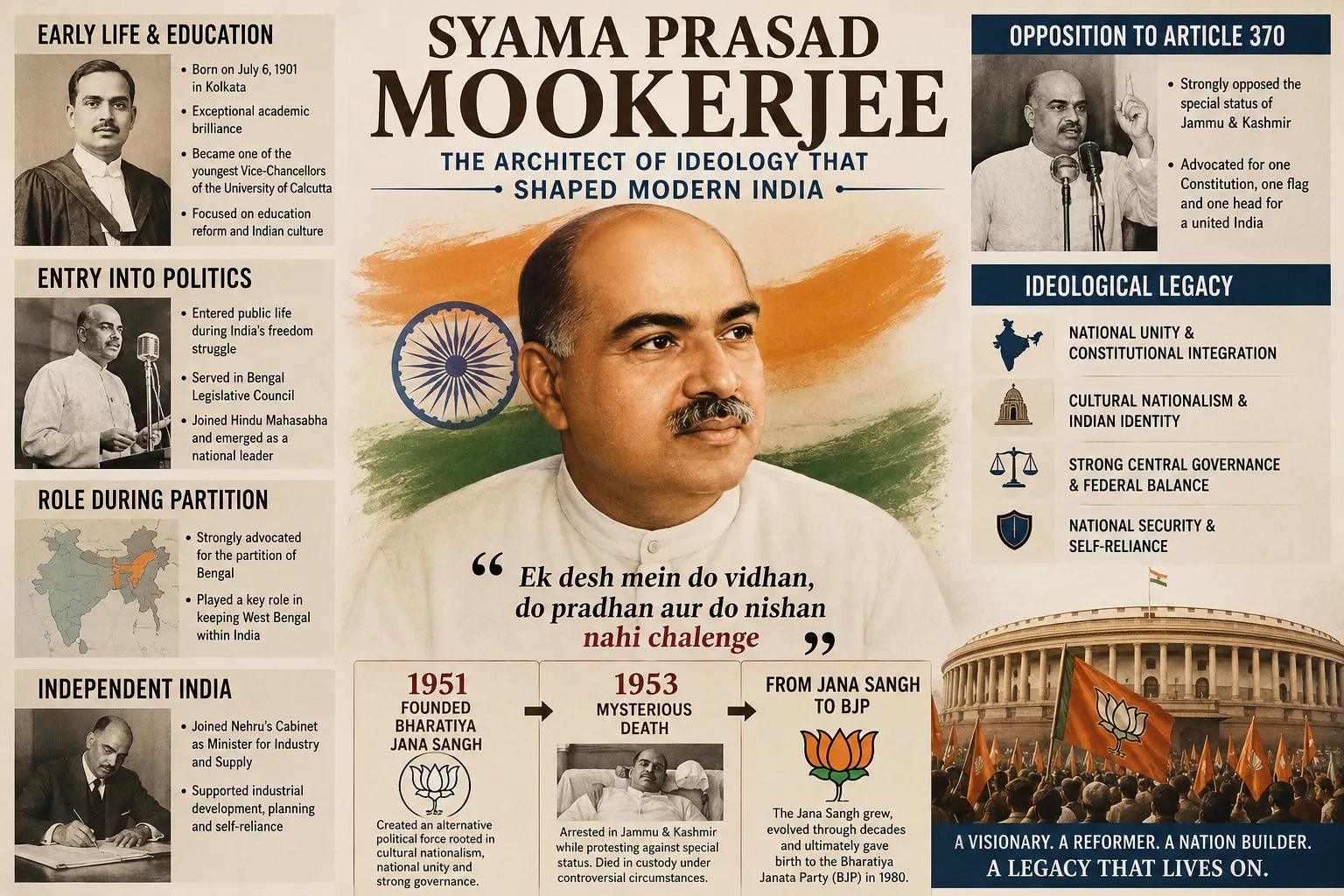
“Ek desh mein do vidhan, do pradhan aur do nishan nahi chalenge”
became a defining political message associated with his movement.
Mookerjee believed that national unity required equal constitutional integration across all Indian states. His opposition to Article 370 later became a central ideological position for the Bharatiya Jana Sangh and eventually the BJP.
Decades later, the BJP government’s decision to revoke Article 370 in 2019 was often linked symbolically to Mookerjee’s long-standing political vision.
Founding of Bharatiya Jana Sangh
In 1951, after resigning from Nehru’s cabinet, Mookerjee founded the Bharatiya Jana Sangh with support from nationalist and ideological groups including the Rashtriya Swayamsevak Sangh (RSS).
The party was created as an alternative political force to challenge the dominance of the Indian National Congress.
The Bharatiya Jana Sangh emphasized:
-
Cultural nationalism
-
National unity
-
Economic self-reliance
-
Strong central governance
-
Protection of Indian cultural identity
At a time when Congress dominated Indian politics, the Jana Sangh represented the rise of organized opposition politics rooted in ideological conviction.
Although initially small in electoral strength, the party gradually expanded its influence across northern and western India.
How Jana Sangh Became the BJP
After Mookerjee’s death in 1953, the Bharatiya Jana Sangh continued growing under several influential leaders.
Over the following decades:
-
The party strengthened organizationally
-
Expanded grassroots networks
-
Developed parliamentary influence
-
Built alliances with anti-Congress groups
In 1977, the Jana Sangh merged into the Janata Party coalition that defeated Congress after the Emergency period imposed by Indira Gandhi.
However, ideological conflicts within the Janata Party eventually led former Jana Sangh leaders to establish the Bharatiya Janata Party (BJP) in 1980.
The BJP inherited much of the ideological framework first articulated by Mookerjee and the Jana Sangh.
Mookerjee’s Ideological Legacy
Syama Prasad Mookerjee is often remembered not just as a politician, but as an ideological architect whose ideas continue influencing Indian politics today.
His legacy remains visible in debates around:
-
National identity
-
Federalism
-
Constitutional integration
-
Cultural nationalism
-
National security
Supporters view him as a visionary who defended India’s unity and civilizational identity during a fragile period of nation-building.
Critics, however, argue that some aspects of his politics contributed to ideological polarization and religious nationalism.
Regardless of political interpretation, his influence on India’s political evolution remains historically important.
The Mystery Surrounding His Death
Mookerjee’s death in 1953 remains one of the most debated episodes in early independent India.
He was arrested after entering Jammu and Kashmir without a permit while protesting the region’s special status. During detention in Srinagar, he fell ill and later died under controversial circumstances.
His supporters raised questions regarding:
-
Medical treatment
-
Administrative negligence
-
Political accountability
The incident intensified political tensions and further strengthened the Jana Sangh’s anti-Article 370 movement.
Even decades later, discussions surrounding his death continue appearing in political and historical debates.
Why He Is Called the ‘Forgotten Architect’
Despite his major political contributions, Mookerjee is often less discussed in mainstream historical narratives compared to other national leaders of his era.
However, his role in:
-
Founding the Jana Sangh
-
Building ideological opposition politics
-
Influencing debates on national integration
-
Shaping the roots of the BJP
makes him one of the most consequential political figures in post-independence India.
Today, as the BJP dominates Indian politics, Mookerjee’s ideas and political philosophy continue receiving renewed attention.
Conclusion
Syama Prasad Mookerjee played a foundational role in shaping modern Indian political discourse. As an educationist, parliamentarian, reformer, and founder of the Bharatiya Jana Sangh, he helped create an ideological framework that eventually evolved into the BJP.
His political journey reflected the tensions and aspirations of a newly independent India grappling with questions of identity, unity, democracy, and constitutional governance.
Whether viewed as a nationalist visionary or a deeply polarizing political figure, Mookerjee’s influence on India’s political history remains impossible to ignore. His legacy continues living through the ideological debates, policies, and political movements that shape contemporary India even today.
iodailynews.com iodailynews.com iodailynews.com iodailynews.com iodailynews.com iodailynews.com iodailynews.com iodailynews.com iodailynews.com iodailynews.com iodailynews.com iodailynews.com iodailynews.com iodailynews.com iodailynews.com iodailynews.com iodailynews.com iodailynews.com iodailynews.com iodailynews.com iodailynews.com iodailynews.com iodailynews.com iodailynews.com iodailynews.com iodailynews.com iodailynews.com iodailynews.com iodailynews.com iodailynews.com iodailynews.com iodailynews.com iodailynews.com iodailynews.com iodailynews.com iodailynews.com iodailynews.com iodailynews.com iodailynews.com iodailynews.com iodailynews.com iodailynews.com iodailynews.com iodailynews.com iodailynews.com iodailynews.com iodailynews.com iodailynews.com iodailynews.com iodailynews.com iodailynews.com iodailynews.com iodailynews.com iodailynews.com iodailynews.com iodailynews.com iodailynews.com iodailynews.com iodailynews.com iodailynews.com iodailynews.com iodailynews.com iodailynews.com iodailynews.com iodailynews.com iodailynews.com iodailynews.com iodailynews.com iodailynews.com iodailynews.com iodailynews.com iodailynews.com iodailynews.com iodailynews.com iodailynews.com iodailynews.com iodailynews.com iodailynews.com iodailynews.com iodailynews.com iodailynews.com iodailynews.com iodailynews.com iodailynews.com iodailynews.com iodailynews.com iodailynews.com iodailynews.com iodailynews.com iodailynews.com iodailynews.com iodailynews.com iodailynews.com iodailynews.com iodailynews.com iodailynews.com iodailynews.com iodailynews.com iodailynews.com iodailynews.com iodailynews.com iodailynews.com iodailynews.com iodailynews.com iodailynews.com iodailynews.com iodailynews.com iodailynews.com iodailynews.com iodailynews.com iodailynews.com iodailynews.com iodailynews.com iodailynews.com iodailynews.com iodailynews.com iodailynews.com iodailynews.com iodailynews.com iodailynews.com iodailynews.com iodailynews.com iodailynews.com iodailynews.com iodailynews.com iodailynews.com iodailynews.com iodailynews.com iodailynews.com iodailynews.com iodailynews.com iodailynews.com iodailynews.com iodailynews.com iodailynews.com iodailynews.com iodailynews.com iodailynews.com iodailynews.com iodailynews.com iodailynews.com iodailynews.com iodailynews.com iodailynews.com iodailynews.com iodailynews.com iodailynews.com iodailynews.com iodailynews.com iodailynews.com iodailynews.com iodailynews.com iodailynews.com iodailynews.com iodailynews.com iodailynews.com iodailynews.com iodailynews.com iodailynews.com iodailynews.com iodailynews.com iodailynews.com iodailynews.com iodailynews.com iodailynews.com iodailynews.com iodailynews.com